International Competition - You Are Another Me
Curatorial presentation by Diana Mereoiu
How does one deal with the reality of another human being? Is it at all possible to escape the inner bubble of our own minds in order to understand something we have no direct experience of? These are questions which have become even more pressing in the light of recent social and humanitarian struggles. The burdens of others reach us in the form of stories, narratives which reduce and replace the complexities of life. Most of the times, we are not even aware of their being no more than that - mere fictions filtered through our inherently biased and distant perspective.
Created under the token of the Mayan greeting "In Lak'ech Ala K'in" (which translates into English as “You are another me”), the competition programme You Are Another Me: On Exile and Shifting Borderscapes consists of films which defy the idea of borders, while exploring the issues of otherness and the limitations of empathy. Tackling the problem head on, these innovative and emotionally-powerful works dissolve the barriers towards our understanding of the others’ plight. Once you become me, there is nothing left to separate us. Both inner and outer walls fall in a cinematically enticing encounter.
In order for this to happen, one must first become aware of the conflict between reality and imposed narratives. In the case of refugees, the mess originated in colonial times and is kept vivid to our attention by means of continuous newscasting. After all, what is history if not the grandest fictional narration of them all, the great simplifier and equalizer of human experience? Inevitably, refugees get caught in the cannibalizing nature of history in the making, in the mixture between reality and fiction. The hybrid documentary We All Love the Seashore, nominated for the European Film Awards, adopts the refreshing perspective of immigrants as co-creators rather than characters in a story. Unveiling the imaginary nature of imposed narratives and fictional boundaries, this poetic short film plays out like a balancing act between the candid and the esoteric.
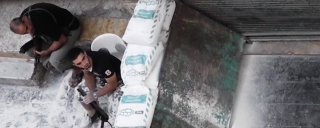
Picking up from where the previous film left off, Over shows that unfortunately, more often than not, the refugees’ journey does not end with salvation. Engaging its audience in a game of attention and patience, it adopts a simple, yet impactful formula to gaze at the stories of those seeking in Europe a promised land of salvation. Nominated for the BAFTA Awards, the European Film Awards and inspired by a true story, the short film uses wide, fixed frames alternating with hand-held close-ups to actively involve the viewers in deciphering and reconstructing a mysterious death told in reverse. But understanding the thread of events doesn’t confer any of the comfort of a solved puzzle. Instead, the shocking, almost surreal ending leaves us with the question, “how could this have happened”, too stunned to dare give an answer.
Nonetheless, there are the lucky ones, albeit their good fortune can prove illusory from a certain point on. By mixing 3D modelling and 16mm footage, Summer reveals how liberating it can be to have your struggles acknowledged and, conversely, how limiting photographs are in telling the stories we so readily consume. A beach frozen in time, as if in a snapshot: people enjoying the sun, a child eating ice-cream, a father taking his picture. But in the frame another character appears. Laboriously making their way out of the waters, a group of refugees crawl to the uncertain safety of the beach, escaping a near-certain death. Premiered at the Berlinale 2016 and inspired by a photograph by Juan Medina, the short is an ingenious and sharp political commentary on the ongoing humanitarian crisis.
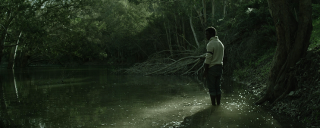
In the midst of all this danger and uncertainty, the wounds of the past, both physical and psychological are not easily appeased. The topic constitutes the core of Sebastian Mez's Remains from the Desert, the chilling tale of a young Eritrean refugee captured, tortured and mutilated for money. As a sober voice-over recounts the experienced horrors, black and white close ups of the thrashed body intertwine with images of the desert where it all took place. Despite all the marks carrying the remembrance of what has happened, the breath-taking landscape remains impassible and unscathed. In the end, the short film recognizes the futility of trying to find logic in the senselessness of torture. The only solace that can be found is the notion that human memory is as fragile as the body, and that bit by bit all will be forgotten.
If individual blanking out can have therapeutic benefits, collective forgetfulness is something we must fight. Raw footage shot from a window, hastily made photographs and a voice-over narration reconstructed post-factum from diary notes paint a gruelling picture of a war in first person. Awarded the Best Short Film Prize by the European Film Academy, 9 Days - From My Window in Aleppo is a harrowing documentary that counters the romanticized view on the Syrian Civil War as presented by the Western press. Through minimalistic means, Syrian photographer Issa Touma, at the same time filming and being filmed, shows how a warfare becomes an integral part of the normalcy of everyday life. As gunshots rattle freely from the window, art becomes the only remaining survival mechanism.
Created under the token of the Mayan greeting "In Lak'ech Ala K'in" (which translates into English as “You are another me”), the competition programme You Are Another Me: On Exile and Shifting Borderscapes consists of films which defy the idea of borders, while exploring the issues of otherness and the limitations of empathy. Tackling the problem head on, these innovative and emotionally-powerful works dissolve the barriers towards our understanding of the others’ plight. Once you become me, there is nothing left to separate us. Both inner and outer walls fall in a cinematically enticing encounter.
In order for this to happen, one must first become aware of the conflict between reality and imposed narratives. In the case of refugees, the mess originated in colonial times and is kept vivid to our attention by means of continuous newscasting. After all, what is history if not the grandest fictional narration of them all, the great simplifier and equalizer of human experience? Inevitably, refugees get caught in the cannibalizing nature of history in the making, in the mixture between reality and fiction. The hybrid documentary We All Love the Seashore, nominated for the European Film Awards, adopts the refreshing perspective of immigrants as co-creators rather than characters in a story. Unveiling the imaginary nature of imposed narratives and fictional boundaries, this poetic short film plays out like a balancing act between the candid and the esoteric.
Picking up from where the previous film left off, Over shows that unfortunately, more often than not, the refugees’ journey does not end with salvation. Engaging its audience in a game of attention and patience, it adopts a simple, yet impactful formula to gaze at the stories of those seeking in Europe a promised land of salvation. Nominated for the BAFTA Awards, the European Film Awards and inspired by a true story, the short film uses wide, fixed frames alternating with hand-held close-ups to actively involve the viewers in deciphering and reconstructing a mysterious death told in reverse. But understanding the thread of events doesn’t confer any of the comfort of a solved puzzle. Instead, the shocking, almost surreal ending leaves us with the question, “how could this have happened”, too stunned to dare give an answer.
Nonetheless, there are the lucky ones, albeit their good fortune can prove illusory from a certain point on. By mixing 3D modelling and 16mm footage, Summer reveals how liberating it can be to have your struggles acknowledged and, conversely, how limiting photographs are in telling the stories we so readily consume. A beach frozen in time, as if in a snapshot: people enjoying the sun, a child eating ice-cream, a father taking his picture. But in the frame another character appears. Laboriously making their way out of the waters, a group of refugees crawl to the uncertain safety of the beach, escaping a near-certain death. Premiered at the Berlinale 2016 and inspired by a photograph by Juan Medina, the short is an ingenious and sharp political commentary on the ongoing humanitarian crisis.
In the midst of all this danger and uncertainty, the wounds of the past, both physical and psychological are not easily appeased. The topic constitutes the core of Sebastian Mez's Remains from the Desert, the chilling tale of a young Eritrean refugee captured, tortured and mutilated for money. As a sober voice-over recounts the experienced horrors, black and white close ups of the thrashed body intertwine with images of the desert where it all took place. Despite all the marks carrying the remembrance of what has happened, the breath-taking landscape remains impassible and unscathed. In the end, the short film recognizes the futility of trying to find logic in the senselessness of torture. The only solace that can be found is the notion that human memory is as fragile as the body, and that bit by bit all will be forgotten.
If individual blanking out can have therapeutic benefits, collective forgetfulness is something we must fight. Raw footage shot from a window, hastily made photographs and a voice-over narration reconstructed post-factum from diary notes paint a gruelling picture of a war in first person. Awarded the Best Short Film Prize by the European Film Academy, 9 Days - From My Window in Aleppo is a harrowing documentary that counters the romanticized view on the Syrian Civil War as presented by the Western press. Through minimalistic means, Syrian photographer Issa Touma, at the same time filming and being filmed, shows how a warfare becomes an integral part of the normalcy of everyday life. As gunshots rattle freely from the window, art becomes the only remaining survival mechanism.