
- You are here: Home > SUMMER
You are here
Cinema Elvire Popesco -
Wednesday, March 29, 2017 - 21:00
Cinema Muzeul Țăranului -
Friday, March 31, 2017 - 21:00
Written by:
Ronny Trocker
Cast:
Umaru Jibirin
Cinematography:
Artur Castro-Freire
Editing:
Ronny Trocker
Sound:
Anouschka Trocker, Enrico Ascoli
Music:
Autistic Daughters / Seby Ciurcina
Producer:
Nicolas Schmerkin, Erik Lampert
Production:
Autour de Minuit Productions, Stempel Films
Romanian Premiere
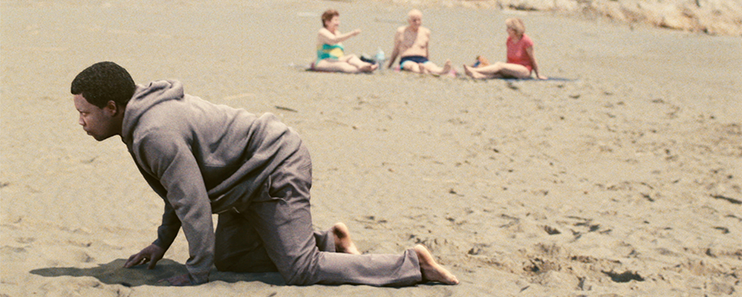
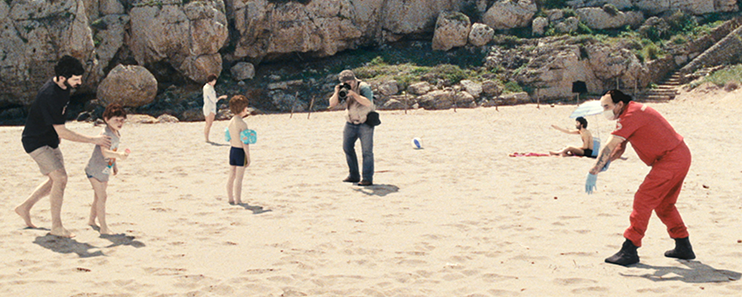
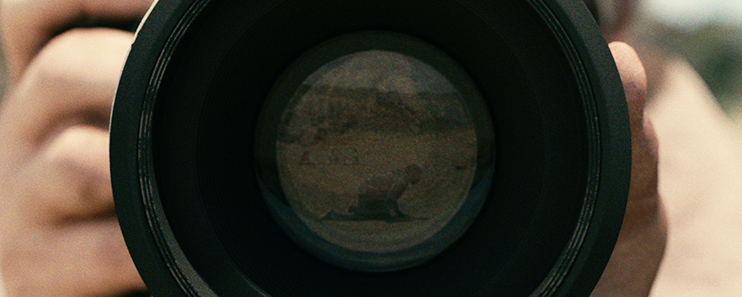
A beach frozen in time, as if in a snapshot: people enjoying the sun, a child eating ice-cream, a father taking his picture. But in the frame another character appears. Laboriously making their way out of the waters, a group of refugees crawl to the uncertain safety of the beach, escaping from near-certain death. Premiered at the Berlinale 2016 and inspired by a photograph by Juan Medina, Summer is an ingenious and sharp political commentary on the ongoing humanitarian crisis. By mixing 3D modelling and 16mm footage, it contrasts stasis and movement, moment and duration and reveals how liberating having your struggles acknowledged is and, conversely, how limiting photographs are in telling the stories we so readily consume. (Diana Mereoiu, BIEFF 2017)
Director:
Contact:
ronnytrocker[at]yahoo[dot]it
Festivals, awards:
- Berlin International Film Festival Shorts 2016
- Clermont-Ferrand International Short Film Festival 2017
- Sarajevo Film Festival 2016
- Winterthur International Short Film Festival 2016
- Hong Kong International Film Festival 2016
- Fantasia International Film Festival 2016
- Chicago International Film Festival 2016
- VIS Vienna Independent Shorts 2016
- Milano Film Festival 2016
Director's statement:
We’re consuming tons of images all day and, most of the time, we don’t even realize what we’re seeing. There are also many images documenting the tragedy of migrants in the Mediterranean Sea, but I think we’re not used to take our time to look at the photos anymore. So, what a film can offer is another way of observation; the audience is invited to explore the photo by following the film and its duration. (Ronny Trocker, Yellow Bread Magazine Interview)
Curatorial comment:
“In Summer, Ronny Trocker creates a hybrid, elastic time, which borrows from both the art of photography as well as that of cinema. In this short, the idea of the snapshot (the 3D body models frozen in time) and that of duration (suggested through the soundscape, materialized in the rhythmic movement of the waves) coexist. Together they become an eloquent discourse about the refugee situation: although we are witnessing a singular moment, it is part of a wider humanitarian crisis spanning decades. The act of seeing and being seen is that which animates the protagonist’s body, the immigrant inching towards the beach from the sea. Once seen, he gains autonomy and can move freely. But when he is captured in a photograph, he freezes once more, imprisoned in the image created by the photographer, in the story that the picture, rather than he himself will say about him.” (Diana Mereoiu, BIEFF 2017)
We’re consuming tons of images all day and, most of the time, we don’t even realize what we’re seeing. There are also many images documenting the tragedy of migrants in the Mediterranean Sea, but I think we’re not used to take our time to look at the photos anymore. So, what a film can offer is another way of observation; the audience is invited to explore the photo by following the film and its duration. (Ronny Trocker, Yellow Bread Magazine Interview)
Curatorial comment:
“In Summer, Ronny Trocker creates a hybrid, elastic time, which borrows from both the art of photography as well as that of cinema. In this short, the idea of the snapshot (the 3D body models frozen in time) and that of duration (suggested through the soundscape, materialized in the rhythmic movement of the waves) coexist. Together they become an eloquent discourse about the refugee situation: although we are witnessing a singular moment, it is part of a wider humanitarian crisis spanning decades. The act of seeing and being seen is that which animates the protagonist’s body, the immigrant inching towards the beach from the sea. Once seen, he gains autonomy and can move freely. But when he is captured in a photograph, he freezes once more, imprisoned in the image created by the photographer, in the story that the picture, rather than he himself will say about him.” (Diana Mereoiu, BIEFF 2017)