
- You are here: Home > Events > Andy Warhol Retrospective - Galateca
You are here
SLEEP (1963, 5h ) - Thursday, December 11th, 5pm
EMPIRE (1964, 8h ) - Saturday, December 13th, 3pm
KISS (1963, ) - Sunday, December 14th, 5pm

@ Galeria Galateca, 2 C.A. Rosetti Street, Bucharest
free entry!
@ Galeria Galateca, 2 C.A. Rosetti Street, Bucharest
free entry!
The films are screened with the support of:
Collection of The Andy Warhol Museum, Pittsburgh
Contribution The Andy Warhol Foundation for the Visual Arts, Inc.
© 2014 The Andy Warhol Museum, Pittsburgh, PA, a museum of Carnegie Institute. All rights reserved.
ANDY WARHOL
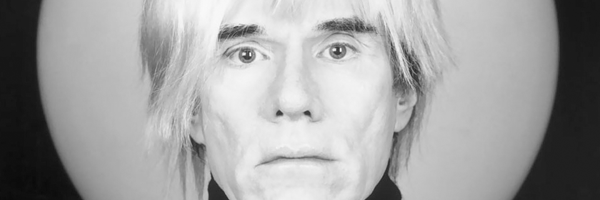
At the beginning of the 60s, Andy Warhol temporarily quit painting - even though he was at the height of his success - and began some new adventures in multimedia. Taking a quick detour into music, Warhol became the manager, producer and overall patron of the up-and-coming band, The Velvet Underground. But film is where he focused his creative energies. Warhol came to the avant-garde cinema in a way no one else had. Despite being a fully developed artist in one medium, he entered the realm of cinematography, but not as an amateur, but with a total commitment. He immediately began to produce major cinema which still echoes to this day. For years he sustained the production of films with undiminished intensity, creating in that time as many major films as any of his contemporaries had in a lifetime. Between 1964 and 1966, the pop artist shot close to 500 short movies - or what he called screen tests - of friends, celebrities and models. And then he shot a series of longer films, or rather anti-films, that challenged the conventions of filmmaking with no three act structures, the first one being Sleep (1963). Originally Warhol wanted to make Brigitte Bardot the star, but he eventually settled for his friend and lover at that time, John Giorno, and the title is self explanatory. Other important films: Kiss (1963), Empire (1964), Screen Test (1964), Blow Job (1964), Batman Dracula (1964), Poor Little Rich Girl (1965), Chelsea Girls (1966). In the early 1970s, most of the films directed by Warhol were pulled out of circulation, but after Andy Warhol's death in 1987, they were slowly restored and are occasionally screened in museums, galleries and film festivals. After 50 years since he made his first film Sleep, Andy Warhol's films are considered instrumental in the development of contemporary cinema and many subsequent generations of film directors and artists cite his films as major influence.
SLEEP (1963)

Sleep (1963) is the first film that Andy Warhol seriously engaged himself in and represents a monumental inversion of the dream tradition within the avant-garde. There was no trance film or mythic dream, but six hours of poet John Giorno sleeping. At the same time, he exploded the myth of compression and the myth of the film-maker: theorists such as Brakhage and Kubelka expounded the law that a film must not waste a frame and that a single film-maker must control all the functions of the creation. Questioning these fixed concepts, Warhol made the profligacy of footage the central fact of all of his early films, and he advertised his indifference to direction, photography, and lighting. He simply turned the camera on and walked away. He made famous the fixed frame in Sleep (1963), in which a half dozen shots are seen for over six hours.
According to Callie Angell in the book The Films of Andy Warhol: Part II, "In July 1963, just after he had purchased his 16mm Bolex, Warhol asked his friend and lover, the poet John Giorno, if he could film him sleeping and began shooting 100-foot silent rolls in Giorno's apartment that summer." John Giorno, the star of Sleep, recalled Warhol asking him on Memorial Day (May 30, 1963) whether he could film him sleeping. The previous month, Warhol had attended a dance performance (April 29 & 30) by choreographer Yvonne Rainer in which one of the dances in the solo section called Terrain was titled Sleep. Although Warhol never credited Rainer's piece with influencing his decision to make a film with the same title, he recalled seeing Rainer's dance at the Judson Dance Theatre in Popism (Warhol's memoir from 1980), referring to it as a "beautiful concert”.
The premiere of Sleep took place on January 17, 1964 at the Grammercy Arts Theater - a benefit screening for the Film-Makers' Cooperative. According to the New York Post, the screening was attended by only nine people - two of whom left during the first hour.
(Trailer)
EMPIRE (1964)
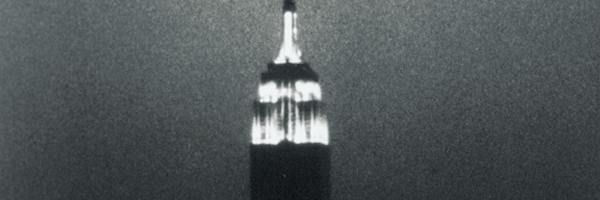
The Empire State Building is a star!
Andy Warhol
Empire is a classic example of Warhol’s early work. He ignored Hollywood conventions by making a film that contained a single image for an extended period of time. Warhol said, “I never liked the idea of picking out certain scenes and pieces of time and putting them together, because… it’s not like life… What I liked was chunks of time all together, every real moment.”
On the night of July 25, 1964, Warhol and a small group of artists headed up to a 41st floor office inside the Time-Life Building in Manhattan with a perfect view of what was then the world's tallest building. Sixteen blocks away from the Empire State Building, Warhol and his group used a 16mm camera and 10:33-minute reels to make their avant garde film. Shooting began at 8 pm and finished at 2:30 am the next morning.
From the dusk of 8pm into the darkness of 2:30 am, Warhol captured the changing lights of the towering structure and the sky above. When Warhol premiered the film, unedited, the following March, he projected it in slow motion, bringing its length to over eight hours.
(Trailer)
KISS (1963)
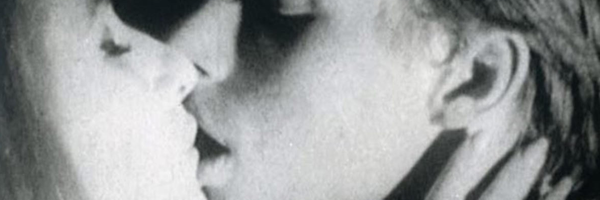
Kiss (1963) is an experimental film directed by Andy Warhol, which runs 50 minutes and features 12 couples kissing for 3:30 minutes each. Out of the 12 kissing couples several are man and woman, woman and woman, man and man, actor Gerard Malanga kisses both men and women, and one is a black man (Rufus Collins). In 1963 this was a daring statement, the polymorphous evaporation of sexual (and racial) identity through the serial fulfilment of romantic dreams. Kiss is probably the artist’s earliest film work that was screened in public. Cinema censors would not allow lips to touch and linger for more than three seconds in Hollywood films, so with Kiss Warhol provides a statement against the conventions of that period. The concept was likely also influenced by a 1929 Greta Garbo film called The Kiss which apparently was screened at Amos Vogel’s influential Cinema 16 experimental film society right around the time that Warhol bought his first Bolex film camera.
The Kiss films were started in 1963 and shown in installments during weekly underground film screenings organized by artist Jonas Mekas. Eventually a 55-minute long version of Kiss was assembled. Among the participants were musician Ed Sanders of The Fugs, actor Rufus Collins from the Living Theatre, sculptor Marisol, artist Robert Indiana, as well as several of the outcasts and doomed beauties who would come to comprise the Factory’s superstars. The woman kissing several men is Naomi Levine, who Andy Warhol referred to as “my first female superstar”.
GALATECA
Galateca is a project created by artists, designers, architects, curators and communication specialists set out to develop exhibitions of applied arts, new multimedia art, a gallery shop that is a total novelty for the market and multidisciplinary cultural experiences, where one could get in touch with contemporary art and amazing personalities. A developing project, Galateca Gallery set out to showcase national and international design projects and original contemporary art, aiming to create valuable exhibitions of applied and multimedia art. Enjoying a very privileged location, in one of Bucharest’s finest historical buildings – the Central University Library – the gallery is situated just across the street from the National Museum of Arts. At Galateca, the relationship between the viewer and the artwork goes beyond the conventional and impersonal display of fine art.