Home

Denmark

    You are here

    • You are here:
    • Home > Denmark
Directed by: 
VICTOR KOSSAKOVSKY
AQUARELA takes audiences on a deeply cinematic journey through the transformative beauty and raw power of water. Captured at a rare 96 frames-per-second, the film is a visceral wake-up call that humans are no match for the sheer force and capricious will of Earth’s most precious element. From the precarious frozen waters of Russia’s Lake Baikal to Miami in the throes of Hurricane Irma to Venezuela’s mighty Angel Falls, water is AQUARELA’s main character, with director VICTOR KOSSAKOVSKY capturing her many personalities in startling cinematic clarity.

AQUARELA is dedicated to fellow Russian filmmaker Alexander Sokurov. In attempting to experiment with new forms of representation, KOSSAKOVSKY, too, sets his camera free. If RUSSIAN ARK brought Sokurov to global attention with one gliding, unbroken long take, AQUARELA flies as well, across the globe. The camera’s mobility allows KOSSAKOVSKY to abstract from the water, creating suggestive patterns from both afar and close up. (Fatima Naqvi, Film Comment)


Cinema is a tremendous tool, but we use it wrong. We are still telling stories. I am beginning to hate this. We shouldn’t tell stories, writers are for that – we have to show something. When we listen to stories, we don’t know what is real life anymore. We believe in stories instead, and if they are good, they can maintain our belief for two thousand years, keeping us from seeing what is real. The storymaker is blind. (VICTOR KOSSAKOVSKY)


"How the hell did they film that?" It is a question that pops up regularly when looking at the impressive images of AQUARELA. Russian director KOSSAKOVSKY used the latest high-tech stabilization equipment and filmed with waterproof HD cameras at 96 frames per second, resulting in an overwhelming cinematography. Water is the protagonist in AQUARELA, but not so much in its gentle, life-giving form. KOSSAKOVSKY shows the raw energy of this force of nature, in all its glory and immeasurable power making people seem very fragile in comparison. (DOCVILLE)


Directed by: 
LARISSA SANSOUR & SØREN LIND
In a barren desert landscape, a lone figure walks among the memories of civilization, while on voice-over we hear her participate in an open and intimate therapy session. She is a narrative terrorist, whose intervention in the future throws a spanner in the cog-machine of historical determinism and entitlement by depositing archeological artifacts for future generations to uncover and legitimize their existence as a disappearing people. Settled among her otherworldly CGI dreamscape of cut-out figures of Western and Eastern culture and politics, the saboteur of history engages her therapist - and us along with them - in breaking down the construction of national identity and dominant historical narratives. In a film where silence and words fall with the same gravity of fragility as porcelain bombs, transcendence turns emotions to abstraction and the personal becomes political. (Andrei Tănăsescu, BIEFF 2017)
Directed by: 
LARISSA SANSOUR, SØREN LIND
IN VITRO is set in the aftermath of an eco-disaster. An abandoned nuclear reactor under the biblical town of Bethlehem has been converted into an enormous orchard. Using heirloom seeds collected in the final days before the apocalypse, a group of scientists are preparing to replant the soil above. In the hospital wing of the underground compound, the orchard’s ailing founder, 70-year-old Dunia is lying in her deathbed, as 30-year-old Alia comes to visit her. Alia is born underground as part of a comprehensive cloning program and has never seen the town she’s destined to rebuild. (Călin Boto, BIEFF)
Directed by: 
STEFAN KRUSE
What happens if we examine what we call the so-called refugee crisis from a different angle: Military recordings, drone photographs, a 360° camera or satellite photographs? What if we look for images we have never seen – or revisit those we have seen but never noticed – and start wondering how they came about and who they are intended for? THE MIGRATING IMAGE follows the pictorial flow of refugees on their journey to and up through Europe. The film is based on photos of refugees and turns the camera back on us – as we created them and ultimately consume them. (Stefan Kruse)
Directed by: 
GABRIEL ABRANTES
In this short comedy, Luis Vaz de Camões, the greatest Portuguese renaissance poet, struggles creatively while engaging in a hedonistic, coprophagic, and drug addled lifestyle. TAPROBANA follows the poet, and his lover Dinamene, as he writes his masterpiece, the epic poem Os Lusiadas. He travels from the cacophony of the Indic jungles, surrounded by allegorical elephants and rhyming macaques, to the frontier of Heaven and Hell, where he is confronted by his fantasy: fame and immortality. (GABRIEL ABRANTES) 
Directed by: 
PETER MUHUMUZA TUKEI & JOHAN OETTINGER
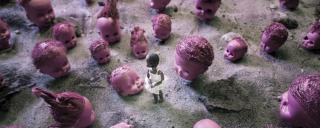
Made within DOX:LAB project of the CPH:DOX Copenhagen International Documentary Film Festival, WALK WITH ME swoops the viewer into a little Ugandan girl’s world of imagination, as she first encounters and tries to make sense of death. Through a mix of live-action and stop motion puppet animation techniques, the demise of one of the girl’s animals is envisioned as a surrealistic struggle between disembodied doll heads and makeshift toy creatures, brought to life by the child’s creativity. Far from being just a film for children, Walk with Me looks upon death with wide, innocent eyes and discovers that the world is both a cruel, but also beautiful place. (Diana Mereoiu, BIEFF)