Home

Le Fresnoy - Studio National des Arts Contemporains

    You are here

    • You are here:
    • Home > Le Fresnoy - Studio National des Arts Contemporains

Directed by: 
DAVID RODES
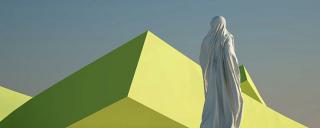
A cerebral wonder of cinematic narration, David Rodes’ film plays out within the liminal realm where thoughts and ideas germinate - the mind. Emanating from its deeply symbolic core, the film envisions its male and female protagonists meeting upon a vast, arid plateau. As their ghostly traces run circles around each other, their real manifestation brings them face to face, under the threat of a colossal electrical sandstorm that is approaching. Words are spoken, glances exchanged and the symbolic offering of an amulet leads to the possibility of contact and communication. Within this simple structure, Ancient Greek mythology is re-envisioned, placing the viewer in the middle of the conceptual plane of the mind. By dramatizing the cosmic meeting between the titans of intellect (Céos) and prophecy (Phoébé), Rodes imparts to the viewer the noblest of offerings: emotion. (Andrei Tănăsescu, BIEFF)
Directed by: 
MIGUEL GOMES
REDEMPTION reveals the fluidity of cinematic meaning and the mechanisms through which collective memory constructs public figures and universal history. Voice-overs attributed to some of the most controversial politicians of our times continuously transform the archive footage into devices of remembrance, idealized reconstructions of the past and projections of the most intimate desires and thoughts. Gomes exposes our natural tendency to construct simplified representations, a mechanism in which we often also cannibalize public figures and their personal histories, draining them of humanness, in our effort to make sense of the world. (Diana Mereoiu, BIEFF)
Directed by: 
MANON COUBIA
Juliet's fate might have been crueller still, had she not been able to see dead Romeo with her own eyes. This what-if scenario is a plausible introduction to Manon Coubia’s cinematic impression of a forlorn life. A woman has spent most of her lifetime waiting for the eternal snows to melt and return the body of her husband, a mountain climber who had died in an accident during an ascent of the Mont Blanc. Under the gaze of the camera, creased bed sheets, complemented by the sound of wind, turn into mountains covered in snow. The wife lies on her bed perpetually, her dreams of the passing of seasons shown in accelerated time-lapse. With its temporal perambulation through times gone by and states of the soul, The Fullness of Time (Romance) is fundamentally a film about eternal love and about the endless power of cinema to get to the deepest core of human experience. (Ioana Florescu, BIEFF 2017)
Directed by: 
ALEXANDRU PETRU BĂDELIȚĂ
In an exercise of self-exorcism, Alexandru Petru Bădeliță gives a moving personal account of his traumatized childhood with a rich profusion of narrative layers and artistic techniques. I Made You, I Kill You, which translates - literally - in the power of life and death the paterfamilias holds over the members of his family, is the ultimate motto for the patriarchal society that rules the life of the author's native village. A collage of family photos and children's drawings mix with animation and with a touch of surrealism in an arresting cinematic whole. Voice-overs take turns and complete the grim picture of a childhood dominated by domestic violence. As in reverberation, the father's account tells of beatings and abuse he had suffered himself as a child, which leads to the dispassionate conclusion that he is not a monster; he simply has no knowledge of another way of life. I Made You, I Kill You casts a poignant uncompromising look at a disturbing world where such experiences are not the exception, but the norm. (Adina Marin, BIEFF 2017)
Directed by: 
EWAN GOLDER
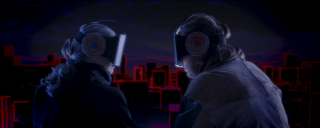
In the harsh neon lights of a virtual cityscape contained within a motherboard, Eugene and Jessica finally meet, after having been paired by an app that matches people according to what they dream. In Binary Love immediate and virtual reality collide: time loses its linearity, the existence of our selves (digital or otherwise) becomes an open-source question and the possibility of human connection falls under scrutiny. In an existentialist twist, digital suicide appears as the only solution: risking it all, going off the grid and searching for a moment of real connection. (Diana Mereoiu, BIEFF 2018)
Directed by: 
ELISABETH CARAVELLA
Originally, HOWTO is presented to us as a conventional video tutorial, but as the computer program used starts becoming unpredictable, throbbing with autonomy, the film develops into an existential quest for meaning and spirituality. Mixing animation, motion capture and CGI, the tutorial evolves into a dynamic struggle for authority between the program and the author. Closing with a hypnotic contemporary dance full of emotion and poetry, Elisabeth Caravella unfolds a philosophical existential crisis, only to guide us to the conclusion that only by letting go and stop resisting change can you truly find yourself. (Gabriela Lupu, BIEFF)
Directed by: 
JORGE JÁCOME
Welcome to Jorge Jácome’s Fiesta Forever, a virtual moon-lit stroll through the post-clubbing landscape haunted by spectral memories of nightlife experiences. Visiting the computer-generated ruined terrain of four clubs, we move freely within their walls, bathed in their abandoned tranquility. These walls can talk, reminiscing about declarations of love, furtive glances and fleeting emotions, pick-up strategies and fateful meetings between soulmates. This sacred ground of the party becomes both a space of solitary refuge and of social gathering and human connection, marked by the experience of its past inhabitants. What we bring, leave behind or take away, as viewers, is entirely up to us. Because by the time the sun comes up, all that remains of it is but a fleeting memory, floating in the realm of humanity’s search for bliss. (Andrei Tănăsescu, BIEFF 2017)
Directed by: 
RANDA MAROUFI
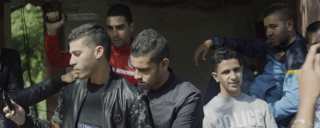
Oftentimes, greener pastures veil arid realities, diverting awareness and placating concern. In the case of Casablanca’s Arab League Park, Randa Maroufi sweeps us past its green idyll and lets us loose ‘on the wrong side of its fence’. Instead of touristic leisure, our floating POV captures derelict carousels among wild vegetation and rubbish-strewn walking paths. This is the stomping ground of Morocco's urban youth, heard through fractured voice-overs as they perform in front of digital cameras for the approval of social media. Materializing this presence-as-posture through still-lifes of bodies in mid-action, The Park offers a (privileged) virtual flânerie in a space where youthful abandon and societal fears converge. (Andrei Tănăsescu, BIEFF)
Directed by: 
ARASH NASSIRI
TEHRAN-GELES flies us over a would-be space, where past and present, memory and imagination merge under luminous Iranian adverts and signs projected over an aerial night-time image of Los Angeles. “During the flight, phone call recordings relate memories of events that took place in Tehran. These stories refer us to the city’s past. In the 1970s and 80s the reality of American life was projected onto Tehran’s social and urban fabric. The revolution brought this period to an end. Like science fiction cinema, in which the present of a city is projected into the future, this video projects the past of Tehran into the present, taking Los Angeles as a setting.” (Le Fresnoy)