Home

Konrad Adenauer Stiftung

    You are here

    • You are here:
    • Home > Konrad Adenauer Stiftung

Directed by: 
DANIEL MCINTYRE
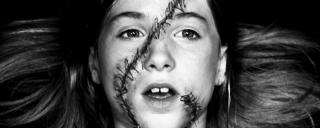
Visually replicating the effects of radioactivity, FOREVER documents the dispersion of radiation and propaganda in the USSR, after the Chernobyl accident, through a woman’s story of adolescence. Personal and universal history collide in a nostalgic bricolage of archive and pop-culture material that creates a complex comparison between the ephemerality of film, that of the human body and of memory. The insistence of the officials on denying the existence of any danger makes the people’s inability to defend themselves painfully concrete. As the image withers into abstraction, the only thing that is left is to accept the imminent threat. (Diana Mereoiu, BIEFF)
Directed by: 
MIGUEL GOMES
REDEMPTION reveals the fluidity of cinematic meaning and the mechanisms through which collective memory constructs public figures and universal history. Voice-overs attributed to some of the most controversial politicians of our times continuously transform the archive footage into devices of remembrance, idealized reconstructions of the past and projections of the most intimate desires and thoughts. Gomes exposes our natural tendency to construct simplified representations, a mechanism in which we often also cannibalize public figures and their personal histories, draining them of humanness, in our effort to make sense of the world. (Diana Mereoiu, BIEFF)
Directed by: 
ROEE ROSEN
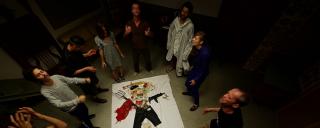
A compilation of videos attributed to a supposed collective of ex-Soviet artists at odds with the values around them, THE BURIED ALIVE VIDEOS centers on a group of cultural zombies who have retreated into isolation and secrecy to make a statement against the present socio-political system. Assembled in a pseudo-documentary fashion, the film fictionalizes reality in order to convey essential truths, through a mix of cynical and absurd humor. Directly attacking capitalism and consumer society, Rosen exposes history as nothing more than a construct, wittingly tackling the taboo around topics such as sexuality and religion. (Diana Mereoiu, BIEFF)
Directed by: 
OLIVIER SMOLDERS
Questioning the history of the artistic avant-garde, THE SHADOW'S SHARE is a work of aestheticized macabre founded on the myth of photography as art that little by little kills its subject. Screened at Clermont-Ferrand, the film explores the pains, obsessions and especially grotesque works of the vanished photographer Oskar Benedek, and weaves around him a whole counterfeit personal history. Offering his protagonist for examination, Smolders violently brings down the viewer from his condescendingly detached position of one who believes he has solved the mystery, and shows him that people cannot be known, much less deciphered. (Diana Mereoiu, BIEFF)
Directed by: 
ELISABETH CARAVELLA
Originally, HOWTO is presented to us as a conventional video tutorial, but as the computer program used starts becoming unpredictable, throbbing with autonomy, the film develops into an existential quest for meaning and spirituality. Mixing animation, motion capture and CGI, the tutorial evolves into a dynamic struggle for authority between the program and the author. Closing with a hypnotic contemporary dance full of emotion and poetry, Elisabeth Caravella unfolds a philosophical existential crisis, only to guide us to the conclusion that only by letting go and stop resisting change can you truly find yourself. (Gabriela Lupu, BIEFF)
Directed by: 
DOUWE DIJKSTRA
In DÉMONTABLE, our domestic space turns into a world reminiscent of Gulliver’s Travels, invaded by miniature projections of the outside world.A funny, playful film on the absurd relationship between daily life and global news. The level of media saturation we’re bombarded with creates an absurd distortion and distance between our daily routine and current affairs. Démontable explores this bizarre melange of realities by throwing the two worlds together: attack helicopters shred a newspaper, while a dinner plate suffers a drone strike. They’re a series of attempts to try and understand our world better by playing with its violent protagonists. (Douwe Dijkstra)
Directed by: 
ARASH NASSIRI
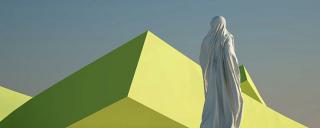
TEHRAN-GELES flies us over a would-be space, where past and present, memory and imagination merge under luminous Iranian adverts and signs projected over an aerial night-time image of Los Angeles. “During the flight, phone call recordings relate memories of events that took place in Tehran. These stories refer us to the city’s past. In the 1970s and 80s the reality of American life was projected onto Tehran’s social and urban fabric. The revolution brought this period to an end. Like science fiction cinema, in which the present of a city is projected into the future, this video projects the past of Tehran into the present, taking Los Angeles as a setting.” (Le Fresnoy)
Directed by: 
ROY DIB
Winner of the TEDDY Award at Berlinale, MONDIAL 2010 is a heart-breaking and deeply insightful musing on love, identity and the borders that restrain and define them. A Lebanese gay couple decides to take a road trip to Ramallah and we experience their journey first-person through the camera lens. Meeting their friends, sight-seeing at the West-Bank wall or simply observing the city as it zooms past the lens, are seen from a privileged perspective that looks beyond the travel-diary surface of the footage, to unravel a disheartening narrative drama. The politics of identity and its complexity have never been so achingly expressed. (Andrei Tănăsescu, BIEFF)
Directed by: 
MAREIKE BERNIEN & KERSTIN SCHROEDINGER
Cheerful, carefree and lively – this is what Nazi Germany looks like in the period’s escapist cinema made ​​on Agfa film stock, which promise colours “truer than true”. Shot in the former factory where the stock was produced, RAINBOW’S GRAVITY examines how images from film and media, by ignoring reality end up rewriting it in the collective memory, and as time goes by, become what we call history. Addressing the issue of the political and ideological implications of colour, the short film portrays a country and a generation suffering from an identity crisis, caught in the struggle of reconciling the past with historical fabrications. (Diana Mereoiu, BIEFF)
Directed by: 
MIRCEA BOBÎNĂ
The 20th century gets broken down to its essentials, in Mircea Bobînă’s history lesson CINESCOPE. Formally recalling the intellectual montage of the Soviets as well as the ironic humour of Bruce Conner, archive footage and historical moments are cut together to sequence the might and plight of modern man. Carried by narrated poetry and pointed nursery rhymes, the film reveals its titular double-entendre as both a microscopic macro-vision of modern civilization and a confirmation for the cinematic dramaturgy that fuels the mechanism of life. (Andrei Tănăsescu, BIEFF)
Directed by: 
DEBORAH STRATMAN
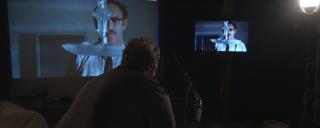
A portrait of a Foley studio, fluidly choreographed in a single-shot, HACKED CIRCUIT reveals the multiple layers of fabrication inherent to filmmaking. Portraying sound artists working on the final scene of Coppola’s The Conversation, Deborah Stratman exposes the invisible mechanisms of cinema, evoking paranoia and uncertainty regarding what we see and hear. Thus she creates an unsettling parallel between the stagecraft of Foley and the pervasive climate of government surveillance that threatens our right to privacy.
Directed by: 
ANDREI POPA
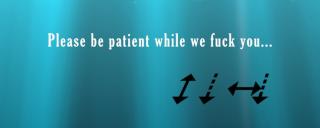
PLEASE BE PATIENT (WHILE WE FUCK YOU) is a metaphor about the society we live in and the direction it is heading to if driven solely by profit. Banks and corporations are more powerful than the state, making their own rules and standards by ignoring human rights and considering people to be objects, numbers or statistics, which must be used for maximum profit with minimum investment. This can be seen by the way companies treat and talk to people, like slaves, without even trying to hide it. All made possible by a herd mentality, lack of independent thought and of initiative on the part of the individual. Although abuses can reach way beyond the absurd, a lot of people accept them, without raising any questions or doing anything about it. (Andrei Popa)
Directed by: 
ALEX MIRONESCU
Yet another sample of creatively repurposing found footage, intelligently combined with fictional elements, THE GOLDEN DREAM is an attempt of deconstructing the communication process, using as a pretext the exponents of two most representative forms of propaganda encountered in recent history. The experimental film captures Adolf Hitler’s defining non-verbal, body language elements, superimposed on the very original speech of Nicolae Ceausescu, with the purpose of observing effective manipulation techniques. (Alex Mironescu)