Dance Cinema from the Netherlands

Curatorial presentation by Diana Mereoiu
After last year's wonderous succes, the special program dedicated to dance-films returns to BIEFF, this time through an inspiring partnership with one of the main European dance-film festivals - CINEDANS - Dance on Screen Festival Amsterdam. Cinema and dance merge in seven charming short films, in which the human body becomes synonymous with emotion, a means of defining one’s own personal identity, of reclaiming the urban space, an expression of love and community.
Dance-film is not a simple transposition of choreography on the screen, but an integrated experience of the two arts, which reveals new facets of the human body. The material, physical part and the emotional, spiritual one are no longer caught in an inevitable dichotomy, but are fully compatible and mutually reinforcing. Thus man re-emerges in a new form, a stronger, more expressive one, fully involved in what he is experiencing, being an organic part of his living environment. Dance thus becomes a form of discovery and self-discovery, an initiation journey. Part of the films from this program reflect on personal development and on universal human experiences.
I AM THE ONLY tells the coming of age story of a boy in the context of a troublesome relationship between him and his family. In symbolic images, we are shown the expanding, undaunted nature of the child, in contrast with the irrational fearing attitude of his older relatives. In a sinister atmosphere the child becomes the parent and the parents become a burden. Allowing a close relationships to form, he quickly learns of their deviant, sick nature that leads to nowhere. In his good intentions, he tries to rescue them, but one by one they fall, leaving him alone. Unsurprisingly, the young adult expresses his joy in a power extruding choreography returning him to his previous innocent self. (Gabriela Lupu, BIEFF)
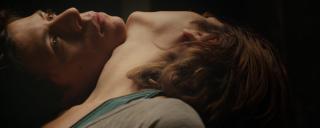
Continuing the coming-of-age story approach, INTRINSIC MORAL EVIL follows a lone male protagonist alone in the middle of a darkened marbled interior. Approached by another man, he enters into a playful game of magnetism, their bodies attracting and repelling each other in sinuous sensuality. Stasis brings forth a third person, the one that separates the two and lures the protagonist in his narrative’s metaphor of personal (sexual) development. Their embracing dance cut short, he is left once again on his own, this time with an assurance and understanding that radiates in the tomb-like interior. A game of attractions and identity, chasing each other to their final destination - that of self-empowerment and pride, glowing in the face of prejudice. (Andrei Tănăsescu, BIEFF)
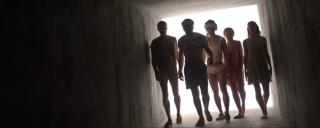
Shifting its gaze towards the universal experience of love, FLIGHT OF LIFE looks at a young couple taking their breakfast in unison and heading off, driving down a mountainside on their way to a birthday party. Everlasting love pulsates the past into the present: as flashbacks recall their first date, the present moves toward unavoidable tragedy. Rhythm and movement secure their bodies in the synchronized dance of life, death being the only disruptive element that cuts off their love’s intense continuity. An effervescent drama, Flight of Life takes the viewer on the timeless and fateful trip that binds two souls to the passage of life. (Andrei Tănăsescu, BIEFF)
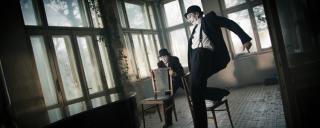
An emotional, expressive film, enriched by a skillful play on genre film conventions (thriller, burlesque comedy, melodrama), BETWEEN ENTRANCE AND EXIT shows life as an abandoned, haunted house, in the captivity of which lay the memories of a heartbreaking love story. In a dysfunctional relationship like an out of tune piano, the two protagonists repeatedly seek and find each other in a labyrinth of rooms and mirrors, each showing a different stage of a dichotomic vicious circle of love and hate. The film successfully combines choreography and film language in a captivating way that triggers empathy and urges reflection on the nature of human desires and the ephemerality of life. (Gabriela Lupu, BIEFF)
If the previous film compressed the experience of love into a few short hours, the next short works as a sort of time-lapse of this sentiment. With a fresh perspective on the role of urban space, HORIZON means the break of the routine, in search for the skyline and balance. The functional essential role of space is reimagined through the protagonist’s playful acrobatics, which enfolds her ignoring the suspicious eyes of the surrounding robotic world. The desperate and disoriented search of the young woman, culminates with the discovery of a wall blocking her way, raising questions about the effect of urban space on personal freedom. Although treated with humor, the film tackles a serious subject, namely that the horizon remains only a concept in a society obsessed with ascending. (Gabriela Lupu, BIEFF)
Shifting its gaze from personal experiences lived in intimacy to the interaction between people, bodies and their surroundings, the next shortfilms show an unconventional repurposing of urban space. Winner of the Audience Award at CINEDANS 2014, SLOW is a performance that shows the defenceless human body surrounded by machines, systems, etc. In Taiwan, like in other Asian countries, there are strict rules people have to live by, rules which cannot be easily put aside. Slowly but imperturbable the boy in the video follows his own path. Using an invisible electric tackle he drags himself in an even tempo through the Taiwanese urban landscape, marking in an entertaining and wondrous way the contrast between the route of the defenseless human body and the hectic world surrounding it.
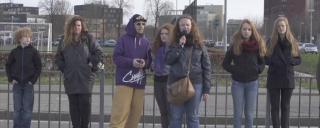
Also concerned with the relationship between the individual and his (this time communal) environment, THE GINGER CONNECTION is a film about being an outsider and belonging, about the unspoken connection between redhead people, seen in correlation with dance. Out on his daily run, the main character, a redhead, is greeted on his way by fellow gingers, getting to compete in skills in a mix of sport movements, gymnastics, street dance and break dance. A special atmosphere is created, by the overlap of permanent violin sounds with various modern pieces underlining the sensibility that lays beyond the strong surface. Exciting, with a potential of socio-artistic manifesto, the film exudes optimism, urging minorities to gather. (Gabriela Lupu, BIEFF)
Dance-film is not a simple transposition of choreography on the screen, but an integrated experience of the two arts, which reveals new facets of the human body. The material, physical part and the emotional, spiritual one are no longer caught in an inevitable dichotomy, but are fully compatible and mutually reinforcing. Thus man re-emerges in a new form, a stronger, more expressive one, fully involved in what he is experiencing, being an organic part of his living environment. Dance thus becomes a form of discovery and self-discovery, an initiation journey. Part of the films from this program reflect on personal development and on universal human experiences.
I AM THE ONLY tells the coming of age story of a boy in the context of a troublesome relationship between him and his family. In symbolic images, we are shown the expanding, undaunted nature of the child, in contrast with the irrational fearing attitude of his older relatives. In a sinister atmosphere the child becomes the parent and the parents become a burden. Allowing a close relationships to form, he quickly learns of their deviant, sick nature that leads to nowhere. In his good intentions, he tries to rescue them, but one by one they fall, leaving him alone. Unsurprisingly, the young adult expresses his joy in a power extruding choreography returning him to his previous innocent self. (Gabriela Lupu, BIEFF)
Continuing the coming-of-age story approach, INTRINSIC MORAL EVIL follows a lone male protagonist alone in the middle of a darkened marbled interior. Approached by another man, he enters into a playful game of magnetism, their bodies attracting and repelling each other in sinuous sensuality. Stasis brings forth a third person, the one that separates the two and lures the protagonist in his narrative’s metaphor of personal (sexual) development. Their embracing dance cut short, he is left once again on his own, this time with an assurance and understanding that radiates in the tomb-like interior. A game of attractions and identity, chasing each other to their final destination - that of self-empowerment and pride, glowing in the face of prejudice. (Andrei Tănăsescu, BIEFF)
Shifting its gaze towards the universal experience of love, FLIGHT OF LIFE looks at a young couple taking their breakfast in unison and heading off, driving down a mountainside on their way to a birthday party. Everlasting love pulsates the past into the present: as flashbacks recall their first date, the present moves toward unavoidable tragedy. Rhythm and movement secure their bodies in the synchronized dance of life, death being the only disruptive element that cuts off their love’s intense continuity. An effervescent drama, Flight of Life takes the viewer on the timeless and fateful trip that binds two souls to the passage of life. (Andrei Tănăsescu, BIEFF)
An emotional, expressive film, enriched by a skillful play on genre film conventions (thriller, burlesque comedy, melodrama), BETWEEN ENTRANCE AND EXIT shows life as an abandoned, haunted house, in the captivity of which lay the memories of a heartbreaking love story. In a dysfunctional relationship like an out of tune piano, the two protagonists repeatedly seek and find each other in a labyrinth of rooms and mirrors, each showing a different stage of a dichotomic vicious circle of love and hate. The film successfully combines choreography and film language in a captivating way that triggers empathy and urges reflection on the nature of human desires and the ephemerality of life. (Gabriela Lupu, BIEFF)
If the previous film compressed the experience of love into a few short hours, the next short works as a sort of time-lapse of this sentiment. With a fresh perspective on the role of urban space, HORIZON means the break of the routine, in search for the skyline and balance. The functional essential role of space is reimagined through the protagonist’s playful acrobatics, which enfolds her ignoring the suspicious eyes of the surrounding robotic world. The desperate and disoriented search of the young woman, culminates with the discovery of a wall blocking her way, raising questions about the effect of urban space on personal freedom. Although treated with humor, the film tackles a serious subject, namely that the horizon remains only a concept in a society obsessed with ascending. (Gabriela Lupu, BIEFF)
Shifting its gaze from personal experiences lived in intimacy to the interaction between people, bodies and their surroundings, the next shortfilms show an unconventional repurposing of urban space. Winner of the Audience Award at CINEDANS 2014, SLOW is a performance that shows the defenceless human body surrounded by machines, systems, etc. In Taiwan, like in other Asian countries, there are strict rules people have to live by, rules which cannot be easily put aside. Slowly but imperturbable the boy in the video follows his own path. Using an invisible electric tackle he drags himself in an even tempo through the Taiwanese urban landscape, marking in an entertaining and wondrous way the contrast between the route of the defenseless human body and the hectic world surrounding it.
Also concerned with the relationship between the individual and his (this time communal) environment, THE GINGER CONNECTION is a film about being an outsider and belonging, about the unspoken connection between redhead people, seen in correlation with dance. Out on his daily run, the main character, a redhead, is greeted on his way by fellow gingers, getting to compete in skills in a mix of sport movements, gymnastics, street dance and break dance. A special atmosphere is created, by the overlap of permanent violin sounds with various modern pieces underlining the sensibility that lays beyond the strong surface. Exciting, with a potential of socio-artistic manifesto, the film exudes optimism, urging minorities to gather. (Gabriela Lupu, BIEFF)