International Competition: Human Nature / Mother Nature
Curatorial presentation by Adina Marin
Although words such as mother and human and nature supposedly rhyme with peace and kindness and beauty, the truth of the matter is that when talking about Mother Nature and Human Civilization we are looking at a love-hate relationship and feel the urge to slip the word versus between the two. There have been voices to announce the beginning of a new geological time, the Human Age coined Anthropocene, due to the enormous (negative) impact of the humans on the environment. But like in a tennis game, whenever the Human player sends a ball over the net, Nature strikes back. Ozone depletion? Deadly storms. Deforestation? Landslides. And so on. Undoubtedly, there is a fight of sorts going on, but the environmental issues, however critical they might be, are only the tip of the iceberg. The films in the competition program Human Nature / Mother Nature take bits of the complicated relation between nature and humankind and look at them with a fresh and inquisitive, cinematic eye.
In Nature: All Rights Reserved, nature is everywhere: the dentist's waiting room is a palm beach (wallpaper), the concrete balcony is green with grass (plastic) and there is a rainforest in the conference room (wallpaper again). It's copyrighted material, of course, but who will question whether the author and first owner, i.e. Nature itself, has given permission of use? Sebastian Mulder skillfully juxtaposes visuals of luxurious nature (static or moving) over dull concrete-and-steel urban images until it becomes difficult to tell the imitations from the real thing. Although the author claims that the conclusion is left to the viewer to draw, one cannot refrain from wondering nonsequitously whether the fake plants will die when one stops pretending to water them.
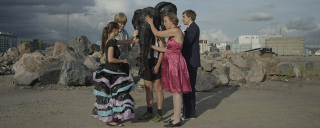
After dragging us into a haunted post-clubbing landscape with his Fiesta Forever last year, Jorge Jácome returns to BIEFF with a different kind of -topia. In Flores the entire population of the Azores archipelago has been supposedly forced to take refuge on the continent because of an unmanageable outburst of the otherwise harmless hydrangeas. The camera follows the only two young soldiers posted on the island with exquisite shots set against the purple and blue backdrop of the floral invasion and explores their stories of nostalgia and sorrow of displacement. There is also talk about harvesting and export and flower treatment, meaning that the banished humans might have been the cause of the unhealthy proliferation after all.
In What There Is to See, landscape is the starting point from which Jaana Kokko embarks on an analysis of its meanings and political perceptions. There is the Romantic Western European landscape, as it appears on the 19th century backdrops of theatre stages. Then the colonial era sets in, depicted in the film by the illustrations in a popular children's book about the voyage of an elephant to a utopian civilized European city. The main layer in the cinematic construction though is the presence of a group of people who act as guides. And because they are visually impaired and therefore can "see" only with their hands, a question promptly pops up: How would the urban landscape look like, if our decisions were based on touch, sound and temperature instead of visual appearance?
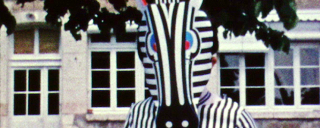
Landscape is the object of dispute between humans and wild animals in After the Volcano. The well-ordered life of a village is interrupted by bursting fire and earth shakes. As the firefighters prove ineffective, the community takes to the forest. Using the mishap as a starting point for his charming mash-up, Léo Favier deals with dead serious topics such as global warming and habitat invasion under the playful form of a fantastic story told with stock footage several decades old. After an attempt to live a hunter-gatherer life, some return to the village, only to discover it had been taken over by animals, much the same as humans had insinuated themselves in the wild. Eventually, we witness a cohabitation of wild creatures, humans and pets and it would look like a happy ending but for the disturbing circular movements of creatures chasing their tails.
Although members of the same species, the humans in They Just Come and Go simply ignore the existence of their fellow beings. At sunrise, a beach becomes the place of surreal encounters. The young try to prolong the remains of the night. The elderly make a start of the coming day. For some brief moments, they move in the same space, without acknowledging each other's existence. The third presence on set is nature. The sand. The sea. The sun. Unlike the humans, it is permanent. Boris Poljak employs stunning images to convey a sense of transience of human existence. All those superbly perfect bodies burning with lust are doomed to turn into decrepit carcasses, same as those walking aimlessly, as in a limbo, in the shallow waters of a sea unchanged, accompanied by the sound of Leonard Cohen's Hallelujah.
In Nature: All Rights Reserved, nature is everywhere: the dentist's waiting room is a palm beach (wallpaper), the concrete balcony is green with grass (plastic) and there is a rainforest in the conference room (wallpaper again). It's copyrighted material, of course, but who will question whether the author and first owner, i.e. Nature itself, has given permission of use? Sebastian Mulder skillfully juxtaposes visuals of luxurious nature (static or moving) over dull concrete-and-steel urban images until it becomes difficult to tell the imitations from the real thing. Although the author claims that the conclusion is left to the viewer to draw, one cannot refrain from wondering nonsequitously whether the fake plants will die when one stops pretending to water them.
After dragging us into a haunted post-clubbing landscape with his Fiesta Forever last year, Jorge Jácome returns to BIEFF with a different kind of -topia. In Flores the entire population of the Azores archipelago has been supposedly forced to take refuge on the continent because of an unmanageable outburst of the otherwise harmless hydrangeas. The camera follows the only two young soldiers posted on the island with exquisite shots set against the purple and blue backdrop of the floral invasion and explores their stories of nostalgia and sorrow of displacement. There is also talk about harvesting and export and flower treatment, meaning that the banished humans might have been the cause of the unhealthy proliferation after all.
In What There Is to See, landscape is the starting point from which Jaana Kokko embarks on an analysis of its meanings and political perceptions. There is the Romantic Western European landscape, as it appears on the 19th century backdrops of theatre stages. Then the colonial era sets in, depicted in the film by the illustrations in a popular children's book about the voyage of an elephant to a utopian civilized European city. The main layer in the cinematic construction though is the presence of a group of people who act as guides. And because they are visually impaired and therefore can "see" only with their hands, a question promptly pops up: How would the urban landscape look like, if our decisions were based on touch, sound and temperature instead of visual appearance?
Landscape is the object of dispute between humans and wild animals in After the Volcano. The well-ordered life of a village is interrupted by bursting fire and earth shakes. As the firefighters prove ineffective, the community takes to the forest. Using the mishap as a starting point for his charming mash-up, Léo Favier deals with dead serious topics such as global warming and habitat invasion under the playful form of a fantastic story told with stock footage several decades old. After an attempt to live a hunter-gatherer life, some return to the village, only to discover it had been taken over by animals, much the same as humans had insinuated themselves in the wild. Eventually, we witness a cohabitation of wild creatures, humans and pets and it would look like a happy ending but for the disturbing circular movements of creatures chasing their tails.
Although members of the same species, the humans in They Just Come and Go simply ignore the existence of their fellow beings. At sunrise, a beach becomes the place of surreal encounters. The young try to prolong the remains of the night. The elderly make a start of the coming day. For some brief moments, they move in the same space, without acknowledging each other's existence. The third presence on set is nature. The sand. The sea. The sun. Unlike the humans, it is permanent. Boris Poljak employs stunning images to convey a sense of transience of human existence. All those superbly perfect bodies burning with lust are doomed to turn into decrepit carcasses, same as those walking aimlessly, as in a limbo, in the shallow waters of a sea unchanged, accompanied by the sound of Leonard Cohen's Hallelujah.