You are here
Rotterdam Film Festival: A Dutch Perspective

Program curated by Peter van Hoof and Theus Zwakhals; presentation by Ioana Florescu
Spanning from reflections on fictionality and reality as a construct to the creative cinematic use of sound and silence and of words and music, the relationship between art, science and human nature, and censorship and the freedom of speech, all the films in program A Dutch Perspective are signed by artists of diverse (non-Dutch) nationalities who have all found in the Netherlands a creative hotspot and a fertile terrain for their artistic enterprise. These directors enrich the Dutch artistic milieu, bringing fresh and unique visual approaches and, at times, tackling in their work issues concerning their often less permissive homelands. And while not all the films in the program make a straightforward approach to the freedom of artistic expression encountered by their makers in the Netherlands, all of them validate it by their mere existence.
Guided by Jean Baudrillard’s notion that reality is a construct and the world has disappeared behind its own representation, The Lost Object focuses on the objects located in a film studio set and the film crew who film them. The absence of diegetic sound, the intentionally odd soundtrack as well as the use of extremely slow camera movements (slowed down even more in editing), make the set itself and reality of the shooting process (fictionalized by being present in the film) appear equally strange, distant and artificial. Hence, Sebastian Diaz Morales’ work reflects both on its own fictionality and on that of the world beyond it. The viewer is left with the challenge to make sense of the glass cubes recurring in the film.
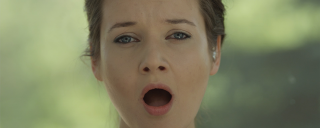
Moving from the visual representation to the auditory realm, AAA (Mein Herz) oscillates between sound, silence, words and music, showing a woman (with piercing blue eyes) simultaneously performing four compositions in a single shot. The video thus confronts us with a sort of reverse TV channel surfing, the abrupt shifts between the individual compositions and sound registers being achieved not necessarily by means of a mechanical interruption, but through the protagonist’s impressive mastering of her facial expression and vocal cords. AAA (Mein Herz) manages to create a polyphonic composition, allowing each of the individual compositions it encompasses to preserve its inherent rhythm. Katarina Zdjelar’s five minute long video work ultimately goes to show that perfectly controlled acting and shifts in soundtrack can enable multiple temporalities to coexist and collide in a single shot.
The voice, this time with its meaning of an attitude expressed, is the subject of Ayhan and Me’s rich meditation on censorship, an alarming issue in present day Turkey. belit sağ embeds the story of the censorship applied to this very project into a far-reaching enquiry on the ethics of representation. Alternating between documenting the repeated rejection of the project and the compelling opinions of famous thinkers about the freedom of expression Ayhan and Me progressively develops into a rich essay on the power of images and, implicitly, on the power and responsibilities of those who control them.
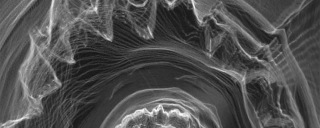
The theme of image potency is approached from a completely different angle in #67. Black and white renditions of electromagnetic waves look like the ocean as seen through a kaleidoscope and then proceed to take on the shape of a spinning wheel as we start hearing what seems to be the sound of motorcycle passing us by. There are endless possibilities for what one may believe to discern on the screen while watching Joost Rekveld’s abstract images. The Dutch artist reprises the theme of the intricate relationship between art, science and human nature in this analog HD video work centered on the concept of 'reafference', a term that refers to the perceptual changes and sensory stimulation caused by movements of the body. The work’s exploration of the fascinating patterns science delivers in its investigation of the human body develops itself the capacity to stimulate visual pleasure.
Equally fascinating, The Sailor reflects on the creation of its own story and the need to use an invented language to express it. In Giovanni Giaretta’s film, image, voice-over and subtitles deliberately fail to synchronize. The links between them are kept wonderfully ambiguous. Landscape stills are slightly abstracted by colour filters; a female voice speaks in Na'vi (the language invented for the film Avatar), and the subtitles muse on the relation between images, words and phantasy. Same as its main character who can no longer distinguish reality from yearning, The Sailor creates an intermedial realm, unwilling to obliterate the abundance of aesthetic and narrative possibilities by putting an end to the story.
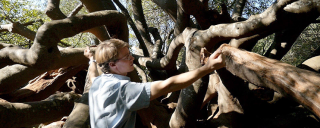
Some stories, though, should not be ended and forgotten. The remains of a huge hedge of wild almond trees now growing in the Cape Town Botanical Garden serve in Judith Westerveld’s film as key element in understanding the history of Dutch colonialism in South Africa. The trees were planted in 1659 by Dutch Commander Jan van Riebeeck with the aim of keeping out indigenous peoples who were raiding the colonists' settlements. By mingling a botanical account on almond trees with the opinions of a tour guide on colonialism, and with fragments from Riebeeck's diary, The Remnant builds a powerful metaphor of colonialism and its aftermaths. The almond branches are so tightly interwoven that they are forced to co-exist, same as the sufferings caused by the colonial past are bound to be remembered, since they are so deeply entwined in the South African present.
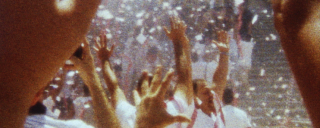
Past and present meet in the flamboyant Explosion Ma Baby which presents us with glimpses of an extravagant annual catholic procession in honor of Saint Sebastian. Using a Super 8 camera and virtuously playing with rhythm and pace, Pauline Curnier Jardin succeeds in conveying the odd sides of the event. Babies wearing garlands made of banknotes are held up by the muscular arms of their fathers, massive amounts of yellow and red confetti erupt from the cathedral’s windows and an ecstatic crowd is screaming and singing. Just like the ritual is an act in which ancient beliefs meet the exuberant present, the film itself becomes the place where the distant and more recent past collide and merge into a singular unfolding of screaming colors and sights.
Guided by Jean Baudrillard’s notion that reality is a construct and the world has disappeared behind its own representation, The Lost Object focuses on the objects located in a film studio set and the film crew who film them. The absence of diegetic sound, the intentionally odd soundtrack as well as the use of extremely slow camera movements (slowed down even more in editing), make the set itself and reality of the shooting process (fictionalized by being present in the film) appear equally strange, distant and artificial. Hence, Sebastian Diaz Morales’ work reflects both on its own fictionality and on that of the world beyond it. The viewer is left with the challenge to make sense of the glass cubes recurring in the film.
Moving from the visual representation to the auditory realm, AAA (Mein Herz) oscillates between sound, silence, words and music, showing a woman (with piercing blue eyes) simultaneously performing four compositions in a single shot. The video thus confronts us with a sort of reverse TV channel surfing, the abrupt shifts between the individual compositions and sound registers being achieved not necessarily by means of a mechanical interruption, but through the protagonist’s impressive mastering of her facial expression and vocal cords. AAA (Mein Herz) manages to create a polyphonic composition, allowing each of the individual compositions it encompasses to preserve its inherent rhythm. Katarina Zdjelar’s five minute long video work ultimately goes to show that perfectly controlled acting and shifts in soundtrack can enable multiple temporalities to coexist and collide in a single shot.
The voice, this time with its meaning of an attitude expressed, is the subject of Ayhan and Me’s rich meditation on censorship, an alarming issue in present day Turkey. belit sağ embeds the story of the censorship applied to this very project into a far-reaching enquiry on the ethics of representation. Alternating between documenting the repeated rejection of the project and the compelling opinions of famous thinkers about the freedom of expression Ayhan and Me progressively develops into a rich essay on the power of images and, implicitly, on the power and responsibilities of those who control them.
The theme of image potency is approached from a completely different angle in #67. Black and white renditions of electromagnetic waves look like the ocean as seen through a kaleidoscope and then proceed to take on the shape of a spinning wheel as we start hearing what seems to be the sound of motorcycle passing us by. There are endless possibilities for what one may believe to discern on the screen while watching Joost Rekveld’s abstract images. The Dutch artist reprises the theme of the intricate relationship between art, science and human nature in this analog HD video work centered on the concept of 'reafference', a term that refers to the perceptual changes and sensory stimulation caused by movements of the body. The work’s exploration of the fascinating patterns science delivers in its investigation of the human body develops itself the capacity to stimulate visual pleasure.
Equally fascinating, The Sailor reflects on the creation of its own story and the need to use an invented language to express it. In Giovanni Giaretta’s film, image, voice-over and subtitles deliberately fail to synchronize. The links between them are kept wonderfully ambiguous. Landscape stills are slightly abstracted by colour filters; a female voice speaks in Na'vi (the language invented for the film Avatar), and the subtitles muse on the relation between images, words and phantasy. Same as its main character who can no longer distinguish reality from yearning, The Sailor creates an intermedial realm, unwilling to obliterate the abundance of aesthetic and narrative possibilities by putting an end to the story.
Some stories, though, should not be ended and forgotten. The remains of a huge hedge of wild almond trees now growing in the Cape Town Botanical Garden serve in Judith Westerveld’s film as key element in understanding the history of Dutch colonialism in South Africa. The trees were planted in 1659 by Dutch Commander Jan van Riebeeck with the aim of keeping out indigenous peoples who were raiding the colonists' settlements. By mingling a botanical account on almond trees with the opinions of a tour guide on colonialism, and with fragments from Riebeeck's diary, The Remnant builds a powerful metaphor of colonialism and its aftermaths. The almond branches are so tightly interwoven that they are forced to co-exist, same as the sufferings caused by the colonial past are bound to be remembered, since they are so deeply entwined in the South African present.
Past and present meet in the flamboyant Explosion Ma Baby which presents us with glimpses of an extravagant annual catholic procession in honor of Saint Sebastian. Using a Super 8 camera and virtuously playing with rhythm and pace, Pauline Curnier Jardin succeeds in conveying the odd sides of the event. Babies wearing garlands made of banknotes are held up by the muscular arms of their fathers, massive amounts of yellow and red confetti erupt from the cathedral’s windows and an ecstatic crowd is screaming and singing. Just like the ritual is an act in which ancient beliefs meet the exuberant present, the film itself becomes the place where the distant and more recent past collide and merge into a singular unfolding of screaming colors and sights.