
- You are here: Home > THE FEMALE GAZE: Cinematic Confessions By Women Filmmakers – Special Program International Short Film Festival OBERHAUSEN
You are here
Bucharest International Experimental Film Festival BIEFF 2014 continues its inspiring long-term collaboration with the legendary International Short Film Festival Oberhausen. With the kind support offered by German Films and Goethe-Institut Bukarest, BIEFF offers Romanian film lovers the chance to see some of the most intriguing works signed by female filmmakers, awarded at the 2014 edition of the Oberhausen festival.
One of the oldest festivals in the world, running for 61 years now, Oberhausen is one of the most important events of its kind in the world, a place where short film meets visual art, particularly well known for its spotlight on experimentation. For more than five decades, many famous filmmakers and visual artists have presented their works at Oberhausen: Roman Polanski, Werner Herzog, Wim Wenders, Chantal Akerman, George Lucas being among them. Roman Polanski: “Short film is an excellent first step for a director. This is how I began my career, and Oberhausen was an essential step on my way to becoming a director.”
Moving from the metaphysical to the tangible, the works included in the Oberhausen theme program THE FEMALE GAZE: Cinematic Confessions by Women Filmmakers bring down the barriers between the film and the viewer. In these experiments of cinematic alterity, the spectator is afforded a higher level of intimacy that invites both an analytical and an emotional observation of the existential anxieties of womanhood.
.png)
A lyrical portrait of Greek identity, Maria Kourkouta’s RETURN TO AEOLUS STREET (ARTE Award - Oberhausen 2014) begins the program’s confessional by navigating through the wandering ghosts of history that long for life’s vitality. Black and white fragments of popular Greek films are looped, superimposed and slowed down in a balletic chiaroscuro, while poetic passages are narrated over melancholy piano pieces. The result is an engrossing audio-visual poem whose hypnotic gaze into a collective consciousness resuscitates its memory and reinvigorates its dormant desires." (Andrei Tănăsescu, BIEFF)
.png)
SEVEN TIMES A DAY WE COMPLAIN ABOUT OUR FATE AND AT NIGHT WE GET UP TO AVOID OUR DREAMS by Susann Maria Hempel (Best Film Award - German Competition Oberhausen 2014) turns to look at the traumatized psyche of a victim of abuse. Fully embracing its subjective form, Hempel narrates the film’s intimate diary-entries and retreats further into the mind of her character by crafting her mise-en-scène with phantasmagorical bric-a-bracs pulled by strings. Hempel’s mesmerizing puppet-show convincingly describes the psychological and physical abuse, drawing the viewer down its downward spiral with childlike fortitude. (Andrei Tănăsescu, BIEFF)
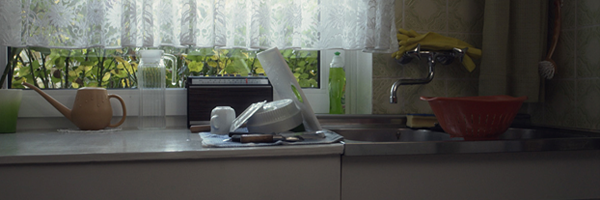
Bringing the narrative disclosures of the program to more familiar territory, Helena Wittmann’s multiple award-winning film THE WILD introduces us to the ideal, peaceful picture of long-lived domesticity. In a sun-filled home, a husband waters the plants while the wife prepares their meal. Yet behind the veneer of their quiet existence, the camera glides slowly through empty rooms, revealing projections of wildlife taking over their home, their sounds striking off against the solitude of old age. THE WILD’s juxtaposition of homely tranquillity with primal savagery invites the viewer to look beyond surface symbolism, coming face-to-face with the primal nature of our domesticized humanity." (Andrei Tănăsescu, BIEFF)
.png)
A celebratory conclusion to the introspective gaze of the program, A MILLION MILES AWAY (ZONTA Award - Oberhausen 2014 - special prize celebrating female filmmakers) tackles the subject of repressed anxiety and teenage angst. Jennifer Reeder’s emotionally rich portrayal of feminine empowerment sees a substitute music-class teacher incapable of quelling her anxieties in front of the class. That is, until the soothing vocal harmonies of her class grant her a sense of maturity and self-esteem. With rich cinematography, flights of magical-realism turn the narrative into a wholly therapeutic experience. A matryoshka doll of layered insecurities and anxieties, Reeder’s film reveals and reveres our inner child, to the rhythm of heavy metal harmonies. (Andrei Tănăsescu, BIEFF)