
- You are here: Home > THROUGH THE BACKDOOR
You are here
Cinema Elvire Popesco -
Tuesday, March 27, 2018 - 18:00
Cinema Muzeul Țăranului -
Thursday, March 29, 2018 - 21:00
Written by:
Karam Natour
Cast:
Karam Natour, Aziz Natour, Sahar Natour
Cinematography:
Karam Natour
Editing:
Karam Natour
Sound:
Karam Natour
Producer:
Karam Natour
Romanian Premiere
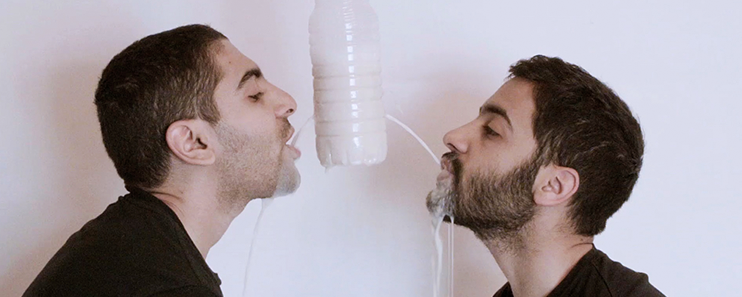
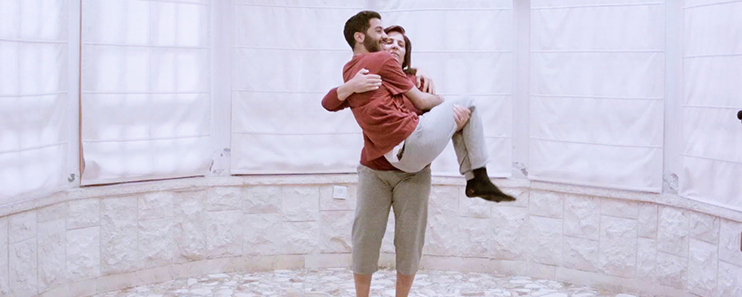
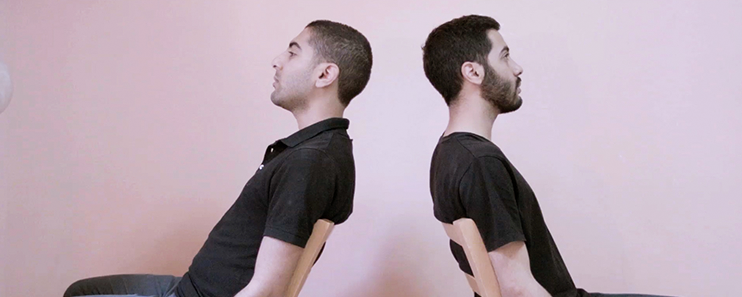
Structured around ten segments evenly split by an aching child ballad (lip-synced in drag), Karam Natour’s Through the Backdoor is a series of vignettes in which his widowed mother and twin brother perform various tasks. The rules for each session are unclear, but easily recognized (follow with one’s eyesight a buzzing fly; answer the mother’s questions at the same time as his brother; compete in burping contest or suckling milk from a bottle). Together, these offbeat acts of fraternal competition and parental devotement accumulate in a portrait of familial dependency and unity. Mischievously endearing, Natour’s performative confessions of emotional (and artistic) neediness, allow us to enter his family’s heart through the back door. (Andrei Tănăsescu, BIEFF 2018)
Director:

Contact:
karamnatour[at]gmail[dot]com
Festivals, awards:
- International Short Film Festival Oberhausen 2017
- Tabor Film Festival, Croatia 2017
- VOID exhibition, Veinti4/Siete Galería, San José, Costa Rica 2017
- The Kids Are All Right exhibition, Oranim College, Israel 2017
- Center of Gravity exhibition, The Djanogly Visual Arts Center, Israel 2016
Curatorial comment:
From the start, Through the Backdoor sets up its rules. The camera observes uninterrupted as the director alongside his widowed mother and/or twin brother, performs a series of tasks within the domestic space of their apartment. Offbeat and wholly entertaining, the performative games involve a form of familial bonding – the twins tipping their chairs against each other to prevent themselves from falling down, suckling together at a milk bottle or performing the quintessential burping contest. At the center of it all, lies the matriarch of the house, Natour’s mother, whose bothered yet fully participatory attitude brings into clearer focus the director’s exhibitionist character. In all these games, regressive states of child-parent dynamics signal an ‘infantile’ need for attention – similarly demanded by an artist’s ego. The power of the film lies in our confrontation with what becomes a home made confessional for NATOUR’s conflated egos (the self-aware artist vs. the innocent infant). Facing it, we get to the film’s final puzzle piece of the father’s physical and emotional absence (rendered in a sobering and heart-wrenching children’s song at the film’s halfway mark). Closure is restored at the end, when the family unit is restructured through the twins’ last performance, of propping up their mother and carrying her across the room – a touching, symbolic gesture of unity. (Andrei Tănăsescu, BIEFF 2018)
From the start, Through the Backdoor sets up its rules. The camera observes uninterrupted as the director alongside his widowed mother and/or twin brother, performs a series of tasks within the domestic space of their apartment. Offbeat and wholly entertaining, the performative games involve a form of familial bonding – the twins tipping their chairs against each other to prevent themselves from falling down, suckling together at a milk bottle or performing the quintessential burping contest. At the center of it all, lies the matriarch of the house, Natour’s mother, whose bothered yet fully participatory attitude brings into clearer focus the director’s exhibitionist character. In all these games, regressive states of child-parent dynamics signal an ‘infantile’ need for attention – similarly demanded by an artist’s ego. The power of the film lies in our confrontation with what becomes a home made confessional for NATOUR’s conflated egos (the self-aware artist vs. the innocent infant). Facing it, we get to the film’s final puzzle piece of the father’s physical and emotional absence (rendered in a sobering and heart-wrenching children’s song at the film’s halfway mark). Closure is restored at the end, when the family unit is restructured through the twins’ last performance, of propping up their mother and carrying her across the room – a touching, symbolic gesture of unity. (Andrei Tănăsescu, BIEFF 2018)