
- You are here: Home > BEHIND THE SUN
You are here
Cinema Elvire Popesco -
Saturday, December 13, 2014 - 17:30
Written by:
Monira Al Qadiri
Editing:
Monira Al Qadiri
Sound:
Fadi Tabbal
International premiere
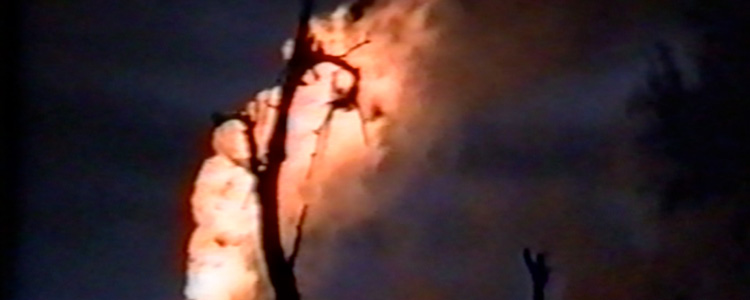
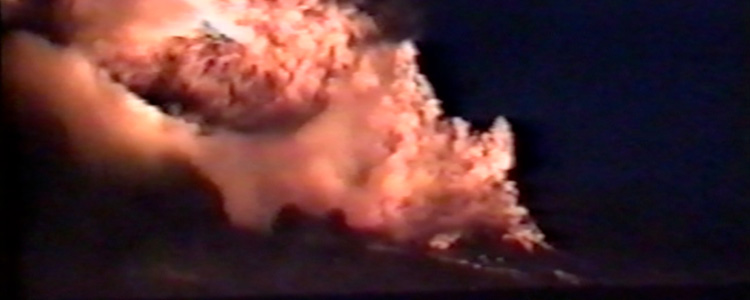
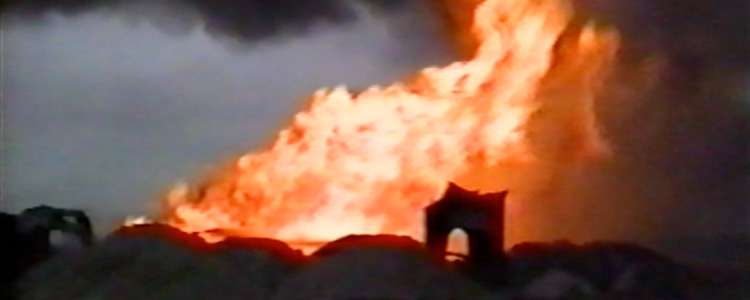
With all the upheavals taking place in today’s uncertain world, how has the image of the apocalypse transformed over time? Is it still imagined within a romantic religious framework, or has it shifted towards darker, more unknown territory? BEHIND THE SUN attempts to explore the decaying portrait of the end of the world by using real-life footage: VHS tapes of the burning oil fields in Kuwait in 1991 - a contemporary update to Werner Herzog’s film Lessons in Darkness. These hellish images are combined with audio monologues from Islamic television programs, creating a picture of sublimity within destruction. (Monira Al Qadiri)
Director:
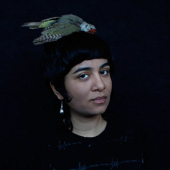
MONIRA AL QADIRI is a Kuwaiti visual artist and film maker born in Senegal and educated in Japan. In 2010, she received a Ph.D. in inter-media art from Tokyo University of the Arts, where her research was focused on the aesthetics of sadness in the Middle-East region stemming from poetry, music, art and religious practices. Her work explores the relationship between narcissism and masculinity, as well as other dysfunctional gender roles in Arab societies. Al Qadiri has taken part in exhibitions and film screenings in Tokyo, Kuwait, Beirut, Dubai, Berlin, New York and Moscow among others.
Website:
Contact:
monira1[at]mac[dot]com
Festivals, awards:
- Berlin International Film Festival 2013
- Whitechapel Gallery, London
- Kunsthalle Exnergasse, Vienna
- Beirut Art Center
Director's statement:
After the first Gulf War in 1991, countless oil fields in Kuwait were set ablaze during the retreat of invading forces. Werner Herzog, lured by the surrealism of this present-day hell, shot his docu-fiction film Lessons of Darkness there, which placed images of the oil fires alongside Christian biblical texts and a Wagner soundtrack. Inspired by his endeavour 20 years later, I am re-exploring this cataclysmic event and attempting to expand its meaning, especially because the idea of imminent doom is even more present in today’s world. Amateur VHS footage of the oil fires is juxtaposed with audio monologues from Islamic television programs of the same period. At the time, the tools used to represent Islam consisted primarily of visualizing God through natural miracles. Trees, waterfalls, mountains, animals and insect life were the visual staples of religious media, and the narration was not that of the Koran, but of beautiful Arabic poetry recited by a skilled orator with a deep voice. This holistic image of religion has been increasingly replaced by social and political interpretations of religious scripture. Therefore, the images of dying nature effectively represent the death of nature within religion. Religion’s subsequent mutation into new extreme imaginaries since that time parallels the transforming portrait of «the end of the world. (Monira Al Qadiri)
After the first Gulf War in 1991, countless oil fields in Kuwait were set ablaze during the retreat of invading forces. Werner Herzog, lured by the surrealism of this present-day hell, shot his docu-fiction film Lessons of Darkness there, which placed images of the oil fires alongside Christian biblical texts and a Wagner soundtrack. Inspired by his endeavour 20 years later, I am re-exploring this cataclysmic event and attempting to expand its meaning, especially because the idea of imminent doom is even more present in today’s world. Amateur VHS footage of the oil fires is juxtaposed with audio monologues from Islamic television programs of the same period. At the time, the tools used to represent Islam consisted primarily of visualizing God through natural miracles. Trees, waterfalls, mountains, animals and insect life were the visual staples of religious media, and the narration was not that of the Koran, but of beautiful Arabic poetry recited by a skilled orator with a deep voice. This holistic image of religion has been increasingly replaced by social and political interpretations of religious scripture. Therefore, the images of dying nature effectively represent the death of nature within religion. Religion’s subsequent mutation into new extreme imaginaries since that time parallels the transforming portrait of «the end of the world. (Monira Al Qadiri)